Showing posts with label science. Show all posts

Sunday, September 30, 2012

Science Post #2: Space and Earth

Because it was covered briefly in our MFW's science curriculcum (Usborne First Encyclopedia of Science) and because I did an "A is for Astronaut" mini-unit with Sissy, we did a lot with Space Science and Earth Science the past two weeks. These are some of the books we read. I recommend any of them. 

As we were reading Moonshot: The Flight of Apollo 11, an award-winning book by Brian Floca, I told the kids we could probably find their real voices online. Here is a really short clip, but there are others we listened to that include more dialogue such as the "giant leap for mankind" quote. They loved this, and it especially helped my 5 year old who had wondered if this was "a true story." There is an illustration in the book of a family cheering in front of the television set, and that (along with the audio clips) gave me tears and goose bumps.
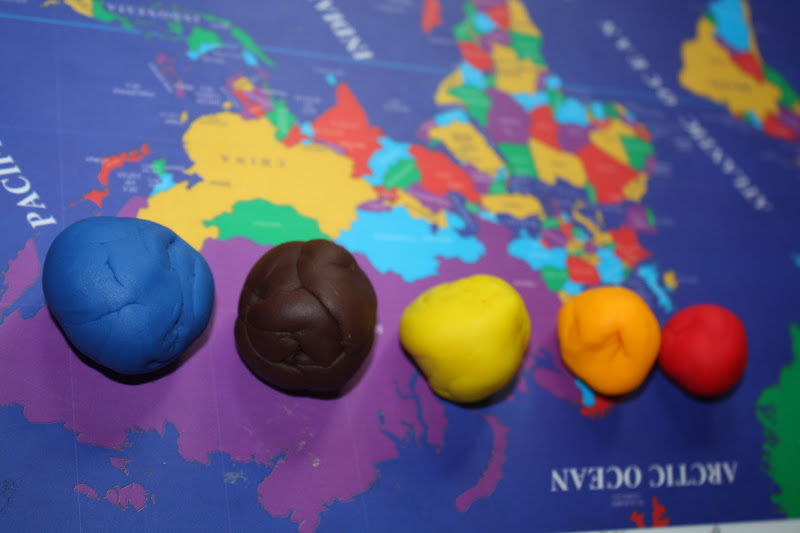
We made play-dough Earths. 
First, they formed these balls of dough, big to small.

They left the red ball solid, then flattened the orange ball to carefully wrap around the red ball. Then the yellow ball was flattened to wrap around the orange/red ball, etc.

After they repeated those steps through blue, they used green play-dough to form continent shapes. We got out the globe, and I asked the kids to each name all 7 continents. Sis can't name them all yet, but she came close with hints.

Next, they cut their dough balls in half. Care needs to be taken with this as the ball will want to squish under the pressure of the knife.

And you will find the 4 layers of the Earth plus the blue ocean on the outside: inner core, outer core, mantle, and crust. (This one looks like it has more layers because because he had to use two shades of yellow mixed together to make a big enough ball. But the yellow is all mantle.)

To review, each filled out this worksheet.

We sang this Layers of the Earth song (which I modified slightly because I couldn't fit that many words into  that tune).

The next day, we reviewed the 4 layers by making edible Earths. I added a little flour and powdered sugar to peanut butter to make it stand up better.

After forming balls (the mantle), we cut them in half, scooped out the center, added soy cream cheese (the outer core) and a strawberry (inner core), then rolled it in ground flax seed (the crust). This didn't turn out as well as I had hoped because the peanut butter consistency wasn't firm enough, but I think it got the point across. And it made for a nice bedtime snack.

I put together this Astronaut Sensory Tub using a Space Toob. I made homemade moon sand (9 cups of flour and about 1 1/2 cups of baby oil). At first, I thought it was just crumbly flour, but it really is moldable! (Sis also got some pink sprinkles in there when she was playing "bakery" with the moon sand.)

When we were reading Space by Bobbie Kalman, my 7 year old kept going over to the space tub to pull out items that matched pictures (like a satellite or certain astronaut gear) in the book.

Also, the first time they played with the moon sand, they were at the kitchen table. On subsequent play times, I had to send them outside because it was very messy.

They were ridiculously impatient waiting for this Oreo experiment. (We actually used this Newman's Organics version.)

I used the printable at the bottom of this page for our model. I edited the word-doc, deleting the pictures for a second sheet to include space for their own cookies.

There was a whole section of space activities at the WonderWorks Museum we visited this month.

#1: Dash, trying out the rocket.

#2: Tornado is pumping his fist "yes" as the monitor (which asks space-related trivia questions) declares his "correct" answer.

#3: This scale calculates your weight on the Moon and Mars. Sis apparently weighs 7 lbs. on the Moon and 16.4 on Mars (and that's 42 lbs. on Earth).

The kids each completed a mini book from this Lifesaver Lessons book.


Magic School Bus: Out of This World teaches about meteorites, so we did this experiment. I filled a baking pan with flour and let them drop rocks into it from different heights with different sized rocks. They repeated this experiment SO many times, for so long, that I finally went inside and just let them have at it. I also showed them pictures online of different meteorites and crater sites in the United States. (BTW, I'm using the flour to make salt dough tomorrow, so it won't go to waste.)


We used these constellation lacing cards. I punched holes on the dots.

The kids placed them on top of construction paper, filled in the dots, then covered them with star stickers. They connected the dots and labeled the constellations.

I asked the kids to design their own constellations.
Tornado named his "Monster," and Dash's was "Bareka." 


Sissy named her constellations "Key-etay" and "Remi."
We blew up this old constellation ball to examine.

styrofoam solar system from Science Post #1

jdaniel4smomScience SundayCachey Mamas Classroom


Sunday, September 2, 2012

Science Post #1

What we have going on this year in science: 
My 12 year old is taking Apologia Swimming Creatures at our home school co-op. This is a terrific choice for Tornado (like Flying Creatures last year) because of the notebook journal style. He loves filling in the sections and cutting and pasting pictures from the Internet and magazines - and all of the lapbook type mini-books, etc.

Science is included in My Father's World curriculum, as well. It mainly takes you through this book, which has a little bit of many scientific subjects, ranging from the solar system to animals. The MFW curriculum set also came with other books and experiments, including Science in the Kitchen and Science with Air. And we'll be adding in other things we're interested in, of course. My 7 year old responds very well to science topics, so I have to put that to use.

It's funny because just as I was typing that above - I gasped; I had totally forgotten about this magnet set that came with the curriculum. I had just seen magnet sensory tubs around and wanted to do one. I guess we will be doing many more magnet experiments in the future, as well.

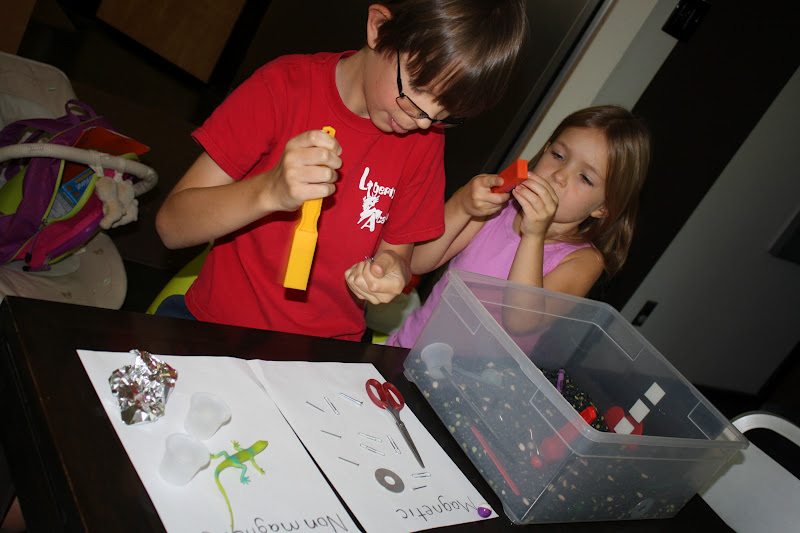
This is our magnet sensory box. 
The base is dry black beans and split peas.

They made predictions to whether each object listed on their assignment sheet (from a Mailbox Science magazine) would be magnetic or non-magnetic.

Then they tested their predictions. Even though I said he loves science, it's funny (or sad) how much Dash dislikes hypothesizing. He hates to be wrong. I can't get him to understand that's just what scientists do; they're sometimes wrong! He feels like a loser when his prediction doesn't match the result. Sigh.

Later, they each had to find every object in the box (which was more than what was included on their prediction sheet) and put it on the appropriate page.

On their own they discovered the magnets worked through a glass or plastic cup.

Um, I think I see a couple of items in the wrong pile.

I printed off this magnet race game from another book, but it was a fail for us. They couldn't get the hang of keeping the magnet far enough away from the paperclip to move it without it jumping to the magnet. 

We watched this DVD, which included a lot of what we were talking about the past two weeks. There is so much packed into 55 minutes. They're going to have to watch it more to help absorb it all, but I have to say I learned (or relearned) so much, too. I want to order the rest of the series.

 Will a egg float better in salt water? We talked about density and molecules.

 Will it float?
They chose 8-10 objects to test.

predictions then results

This experiment was a little precarious. Oranges should float with the peel but sink without the peel. They, of course, guessed that it would be the opposite and were surprised of the results. We used clementines because when I tried the orange ahead of time it wasn't floating very well. There are tiny air pockets in an orange peel causing it to have a lower density. To create a better distinction I should have used a deeper pool of water, which I think was the problem.

Ryan used Legos as a good example to explain molecules/atoms. On another day we talked more about density. They poured water, syrup, then oil in a glass and watched the layers of syrup, water, then oil form.

They took it further by adding food coloring to another cup of water and watching the oil rise.

After we read the solar system lesson in First Encyclopedia of Science, they worked on their own solar system (kit from Wal-Mart).

We still need to paint the base. I was happy for Pluto still representin'! I taught them "My Very Educated Mother Just Served Us Nine Pickles" but told them now it's really "My Very Educated Mother Just Served Us Noodles."  

Science Sunday